By plate or by VIN
One HTTP call with the key in a header. No OAuth, no sessions to keep, no mandatory SDK.
One call with the plate or the VIN and you get the vehicle’s data from Costa Rica’s National Registry: specifications, owners, liens, annotations and violations. Contracted by quote and consumed only through the API.
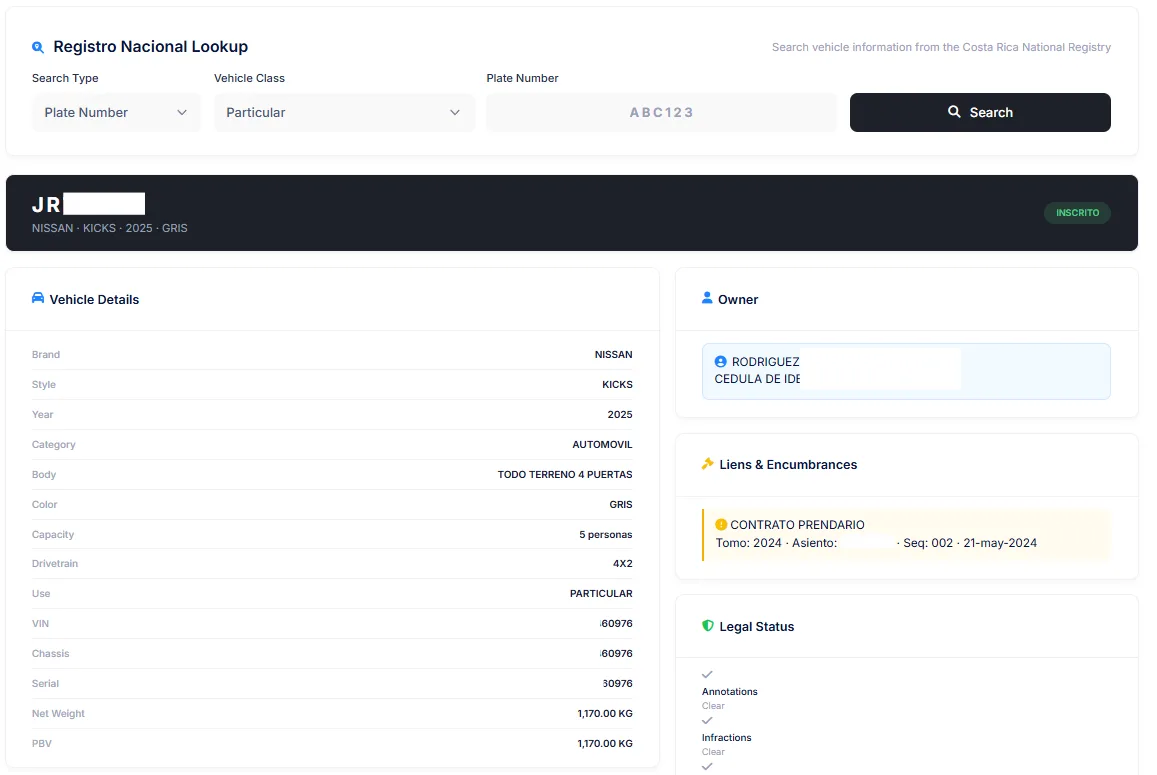
Anyone who looks up vehicles daily knows the problem: the Registry session drops, you log in again, the system asks for a captcha, and multiply that by every lookup of the day. The API handles all of that on its side and your system just receives the data.
All in one system
One HTTP call with the key in a header. No OAuth, no sessions to keep, no mandatory SDK.
Vehicle, engine, owners and registry status — liens, annotations, infractions and releases — as JSON.
Whatever the Registry does not publish for a vehicle is returned empty. Never invented.
Every response says whether it was charged and how much balance is left, in the body and in the headers. No need to trust it: verify it.
A vehicle that does not exist and a Registry that is down are two different codes, and your code can tell them apart.
You can develop against a case with liens without querying a real person's plate.
Why this one
The National Registry publishes no API of its own. Querying it from code means the ViewState, the WAF, the per-account cap and a parser that breaks by itself: we maintain that.
From your own portal, and you revoke them whenever you want.
Failed ones are not deducted, including the ones the Registry answers halfway.
Who it's for
If your business depends on knowing what a vehicle is and whose it is before deciding, this removes the slow part.
Quote and underwrite with real specifications and liens in view, without waiting for a manual lookup.
Know in seconds whether the car about to arrive is pledged or annotated.
Verify the collateral before disbursing, and verify it again afterwards.
Preload the vehicle record from the plate alone instead of typing it at the counter.
Keep dozens of units current without someone dedicated to looking them up.
Check registry status before a transfer, with the query kept on record.
Validate a listing against the registry and show a trustworthy record.
Identify the unit with certainty when opening a case.
There is no portal to log into and no username to remember. It is contracted by quote based on volume and consumed from your own system.
Frequently asked
The National Registry publishes none of its own. This service queries by plate or VIN and returns the information as JSON, with one HTTP call and the key in a header.
You start free with 10 queries, no card, and 7 days to try it. Monthly plans are Starter at $11.30 for 100 queries, Pro at $22.60 for 250 and Business at $33.90 for 500. There is also prepaid with no monthly fee: a 100-query top-up for $11.30, valid for 12 months. Prices are in dollars with 13% VAT included.
Four blocks: vehicle (make, style, year, colour, body, capacity, VIN), engine (number, displacement, cylinders, fuel, power), owners (name, ID, percentage, right) and registry status (liens, annotations, infractions and releases).
No. We present what the National Registry publishes: we do not generate it, validate it or certify it. A legal procedure needs a registry certification and this does not replace one.
The service depends on it: if the Registry is down or slow, the query fails. When that happens it is not charged, and the response says so with a code your system can read.
No. Owner data reaches identified clients through the API with every query logged, and never in the open demo on the page. It is not a people search.
It is one HTTP call with your key in the `X-API-Key` header. There are examples in cURL, Python, JavaScript and PHP.
Tell us the volume and the use case and we will send the quote along with the API documentation.